
Guide for clinic owners
Local SEO for doctors and clinics
How local search works for a medical practice, what changes between dermatology, physiotherapy and dental, what it should cost, and what it cannot do.
17 August 2026 · 11 min read · CareInflow
Most guides on this subject are written by generalist agencies who swapped the word “restaurant” for “clinic” and published. The advice is not wrong. It is just not specific enough to act on, because the thing that actually decides whether a dermatology clinic gets found is not the thing that decides it for a physiotherapist.
This is the version we would want if we ran a practice: what local search weighs, what genuinely differs by specialty, what it should cost, and the part almost nobody publishes, which is what local SEO cannot do for you.
What is local SEO for a doctor or clinic?
Local SEO is the work of being the clinic Google shows when somebody nearby searches for the care you provide.
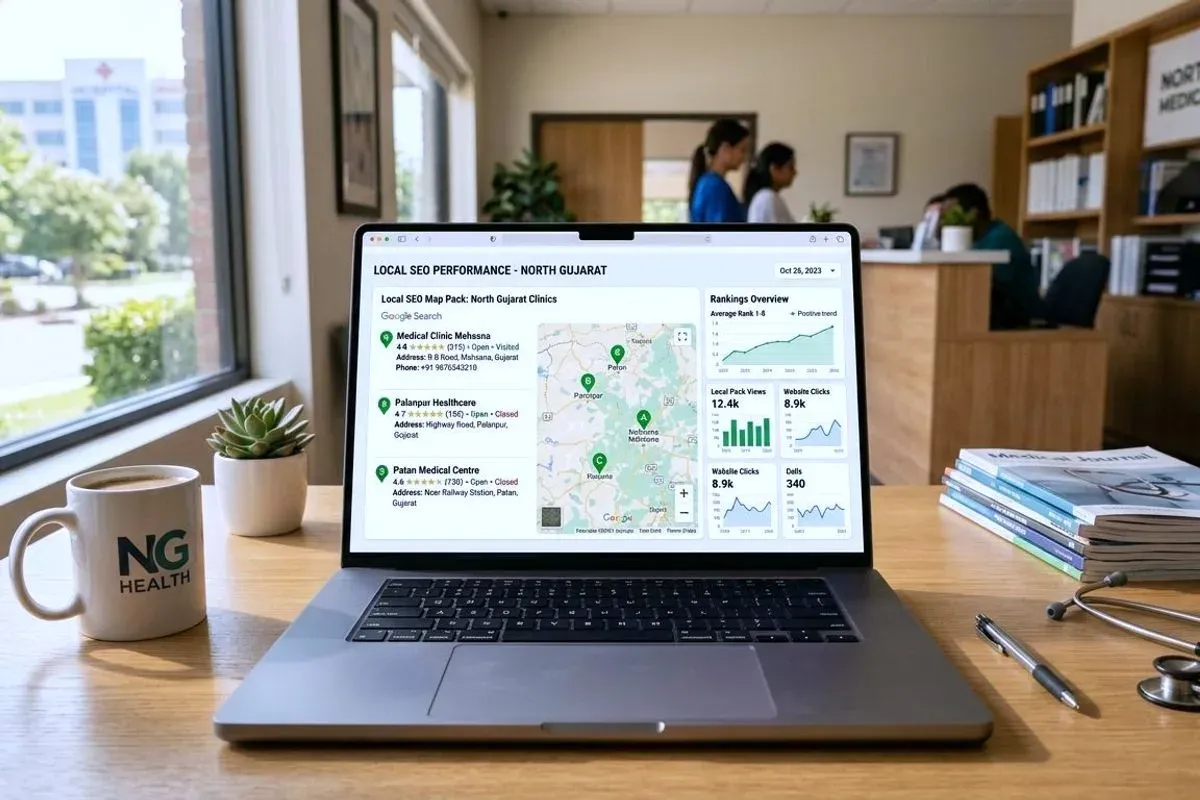
That is two separate results, and practices often only think about one. The first is the map block near the top with three listings, a map and star ratings, which comes from your Google Business Profile. The second is the ordinary blue-link results underneath, which come from your website. They are ranked differently, they can be won separately, and a practice with a strong listing and a weak website will keep losing the patient who scrolls.
Local SEO is not advertising. You are not buying the position, which is why it takes longer and why it keeps working after you stop paying.
What decides which clinics Google shows?
For local results Google weighs three broad things, and it is worth knowing which of them you can actually move.
Relevance. Whether your online presence clearly says you do the thing that was searched. A clinic with a real page about frozen shoulder is more relevant to “frozen shoulder treatment” than a clinic with a Services list that mentions physiotherapy. This is the factor you control most directly, and the one most practices neglect.
Distance. How close you are to the person searching. You cannot change this at all. Its existence is the reason the other two matter so much: you are not competing with every clinic in the state, only with the ones near enough to be plausible.
Prominence. How established you look. Reviews and how you answer them, a complete and active listing, mentions of the practice elsewhere on the web, and whether your name, address and phone number agree everywhere they appear. This is the slowest to build and the hardest to fake.
What changes between specialties?
Here is the part the general advice skips. The same three factors apply, but what “relevance” means in practice differs enough between specialties to change what you should build first.
Dermatology and skin clinics
A skin clinic serves two patients who behave nothing alike, and the site has to serve both without confusing either.
The medical patient searches a problem and wants reassurance: “fungal infection not going away”, “psoriasis doctor”. The cosmetic patient searches a procedure and a price: “laser hair removal price”, “acne scar removal”. The first is anxious and comparing competence. The second is shopping and comparing cost.
The practical consequence is that medical and cosmetic need separate, clearly-signposted paths rather than one blended treatment list. A patient worried about a spreading rash who lands in a page about aesthetic packages leaves. There is also a real compliance dimension here that other specialties do not have, around before-and-after photography and consent, which we cover on the dermatology clinic page.
Physiotherapy clinics
Physiotherapy has the widest gap between what the clinic sells and what the patient types, and closing that gap is most of the work.
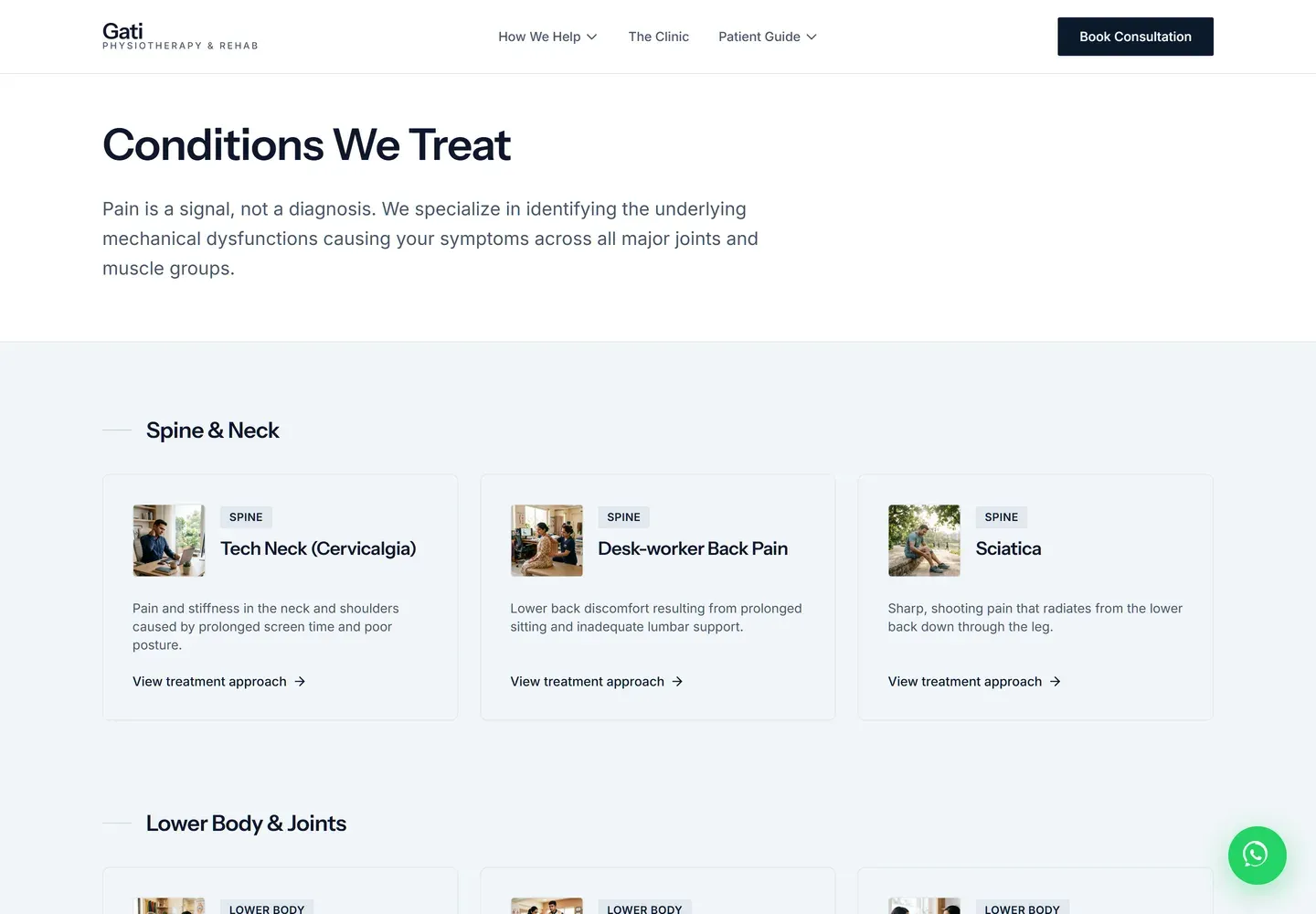
The clinic performs manual therapy, dry needling, progressive loading. The patient has a shoulder that will not lift. Nobody searches “orthopaedic manual therapy”; they search “back pain treatment near me”, “frozen shoulder exercises”, “physiotherapy after knee surgery”. A site organised around modalities is accurate and close to invisible.
So the highest-value structure for a physio clinic is a page per condition, titled the way a patient says it, with the clinical term second. Two other things move the needle unusually hard here: publishing a realistic session range, because patients arrive suspecting an open-ended commitment, and describing the first appointment plainly, because most people have never had physiotherapy and do not know whether to expect a conversation, an examination or pain. Our physiotherapy sample site is built this way end to end if you want to see it working, and the physiotherapy clinic page sets out the reasoning.
Dental clinics
Dentistry is the specialty where urgency and price dominate, and where the map block matters most.
“Tooth pain at night”, “dentist open now near me”, “broken tooth what to do” are searches from someone who needs help today and is choosing in minutes. That puts unusual weight on things a website person might treat as housekeeping: opening hours that are actually right, an emergency number that works, and a phone that a person answers.
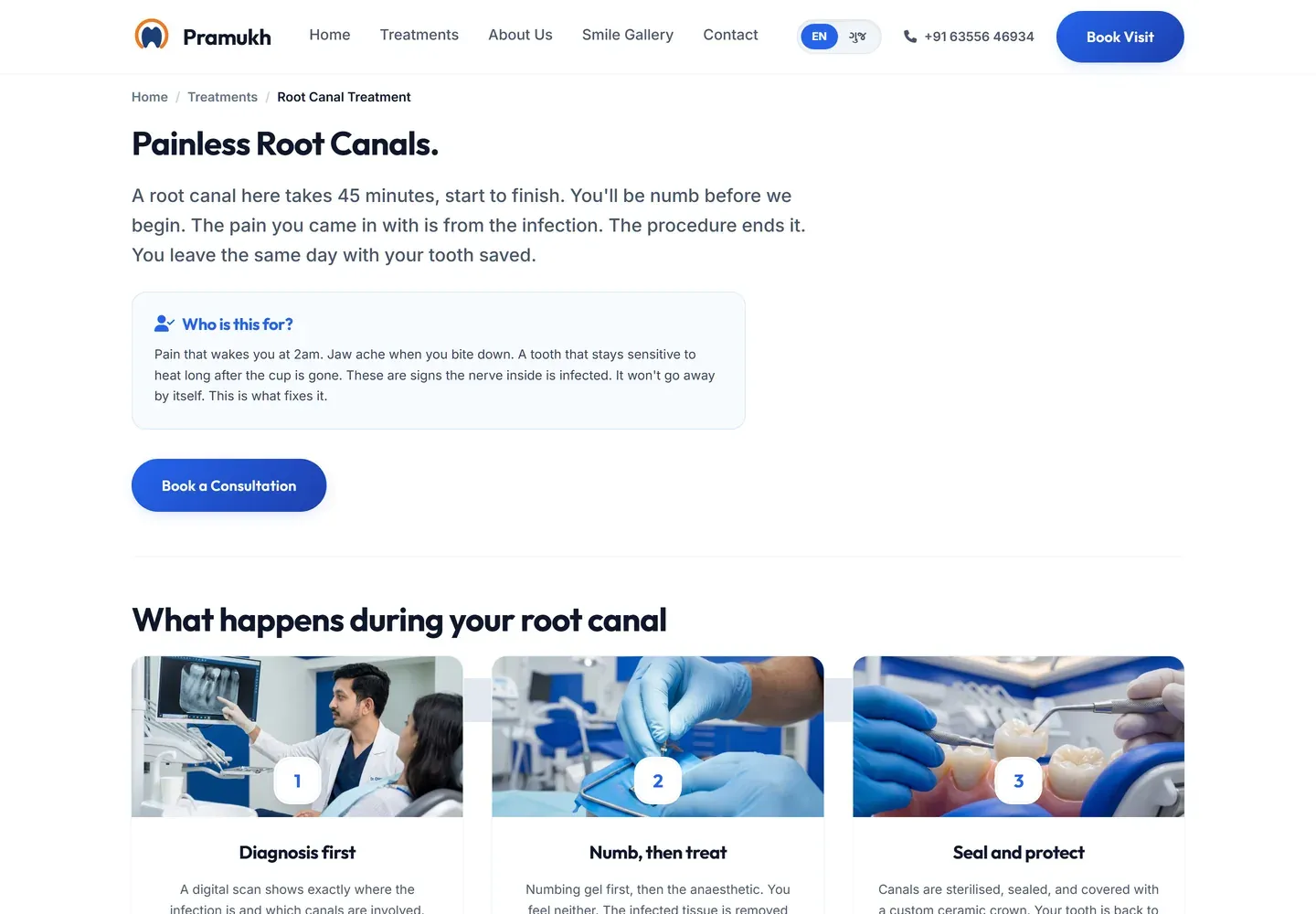
The other half is cost comparison, patiently done: “root canal cost”, “braces vs aligners”, “teeth cleaning price”. Publishing indicative costs is uncomfortable for a lot of practices and it is what the patient is looking for. The clinic that answers gets the enquiry from the patient who was going to ask anyway.
The dental clinic we built in Mehsana is organised around exactly this split, a page per treatment leading with the symptom and the cost question, and the dental clinic page sets out the rest.
What groundwork applies whatever the specialty?
Four things, in roughly the order they pay back.
One version of your details, everywhere. Name, address and phone number identical on your website, your Google listing and every directory carrying your practice. Every disagreement costs a little confidence, and there are usually more of them than you expect.
A page for each thing you want to be found for. Not a Services list. Each treatment or condition a genuine page, written in the words patients use rather than the words on your certificate. This is the single highest-value structural decision, and it is what a clinic website actually needs is mostly about.
Structured data. A machine-readable label on your pages saying this is a medical clinic, at this address, offering these services. It helps a search engine describe you correctly, including in the answers it now writes above the results. Most clinic sites in this region have none.
Speed on a real phone. Google measures how actual visitors experience your site, and nearly every patient search here happens on a mid-range Android on mobile data. Speed is both a ranking input and the first thing a patient judges you on, which we go into in website speed and patient trust.
How much should local SEO cost?
This is one of the most asked questions on the subject and one of the least answered, so here is a straight version.
Pricing in this market ranges from a few thousand rupees a month to well over a lakh, and the range is real rather than a matter of quality alone. What legitimately moves it is how many treatments you need pages for, how many locations you have, how competitive your city is, and whether somebody is maintaining the work monthly or doing it once and leaving.
Two things should make you suspicious rather than pleased. A quote that arrives without anyone asking what treatments you offer or looking at your current listing is a package, not a plan. And any price attached to a ranking guarantee is being set by someone who does not control the outcome they are selling.
We publish our prices in full, including what moves them and what we never charge for, so you can compare before speaking to anybody. The final figure is fixed in writing after a free review, not estimated upward later.
Which tactics backfire?
Paying for a guaranteed first position, which nobody can control. Buying backlinks or reviews, both of which Google detects and penalises, and the second of which also costs you the trust it was meant to buy. Stuffing city names into every sentence, which is demoted and reads terribly to the patients you were trying to impress. Spinning one treatment page into fifteen near-identical pages with the town name swapped, which is the classic thin-content trap.
The pattern is consistent: if a tactic feels like a trick, Google has usually already built the detector, and the cost of being caught lands on the practice rather than the agency that suggested it.
What local SEO cannot do
Worth saying plainly, because the rest of this page would otherwise read as a sales pitch.
It cannot guarantee a position. Nobody can. Anyone who does is either misinformed or counting on you not checking.
It cannot beat distance. If a patient is searching from thirty kilometres away and there is a comparable clinic around the corner, the map block will usually favour the corner. Being found further out means being relevant enough to be worth the drive, not out-optimising geography.
It cannot outrun a genuinely bad experience. Rankings bring people to the door. A rude front desk, a two-hour wait or an unanswered phone converts them straight into the reviews that undo the rankings.
It does not work on a schedule you can promise. Indexing takes weeks, movement takes months, durable position takes quarters. Any timeline more confident than that is invented.
How long before anything moves?
Weeks for Google to see the changes, months for position to shift, quarters for it to become durable and hard for a competitor to take back.
That pace is genuinely the good news. Slow-compounding work is work your better-funded competitor cannot simply buy past next quarter. The practices that do the groundwork keep the advantage precisely because it took a while to earn.
Set up Google Search Console on day one either way. It is free, it shows you the searches you actually appear for rather than the ones you assumed, and without it you are guessing.
If you would rather see where you stand before deciding anything, our free written review covers your listing, your load time, your treatment page coverage and the three clinics currently above you. If the honest answer is that you should change nothing, we will say that.