
Specialty · Dermatology & cosmetic
Dermatology and cosmetic clinic websites that answer first
A dermatology clinic serves two patients who want nothing to do with each other: one worried, one shopping. Keep their paths apart.

- pages that earn their place
- 6
- pages that earn their place
- listing categories that fit
- 5
- listing categories that fit
- searches written to
- 6
- searches written to
In the patient's words
What these patients actually type
Not the clinical name for it. These are the searches your pages have to be written to answer, in the words the patient used.
Who are the two patients a skin clinic serves?
A dermatology practice serves two people whose needs pull in opposite directions.
One has had a rash for four months, has tried three creams, and is quietly worried it is something serious. They want to know you are a doctor, that you will look properly, and how soon they can be seen.
The other is choosing between three clinics for laser hair reduction and comparing price, technology and results. They are shopping, and they know it.
A website built for the second patient can lose the first entirely. If the first thing a worried patient sees is cosmetic pricing and glossy result photographs, a reasonable number of them conclude they have found a beauty clinic and keep searching.
How should medical and cosmetic pages be separated?
The answer is not to bury the cosmetic work. It earns its place, and for many practices it funds the medical side.
It is to split the two routes at the top of the site, so each patient reaches their own set of pages within one decision. Medical dermatology gets pages that read like medicine, conditions, causes, what a consultation involves, when to come in sooner. Cosmetic dermatology gets pages that read like a considered purchase, sittings, realistic outcomes, aftercare, honest cost ranges.
Same practice, same standard, two front doors.
Can a skin clinic publish before-and-after photographs?
Before-and-after images are the strongest evidence a skin clinic has, and the easiest thing to handle badly.
We only publish them with written consent that is specific to website use and can be withdrawn, and we build the record of that consent into how the page is maintained: not as a one-time step that nobody can find in two years. If a patient withdraws consent, the image comes down and that is the end of it.
Where consent is not available, the alternative is not an empty page. It is careful writing: what the treatment does, what a realistic result looks like, how many sittings that usually takes, and what it will not fix. Patients comparing clinics read that more closely than they look at photographs, because photographs are the one thing they already assume can be selected.
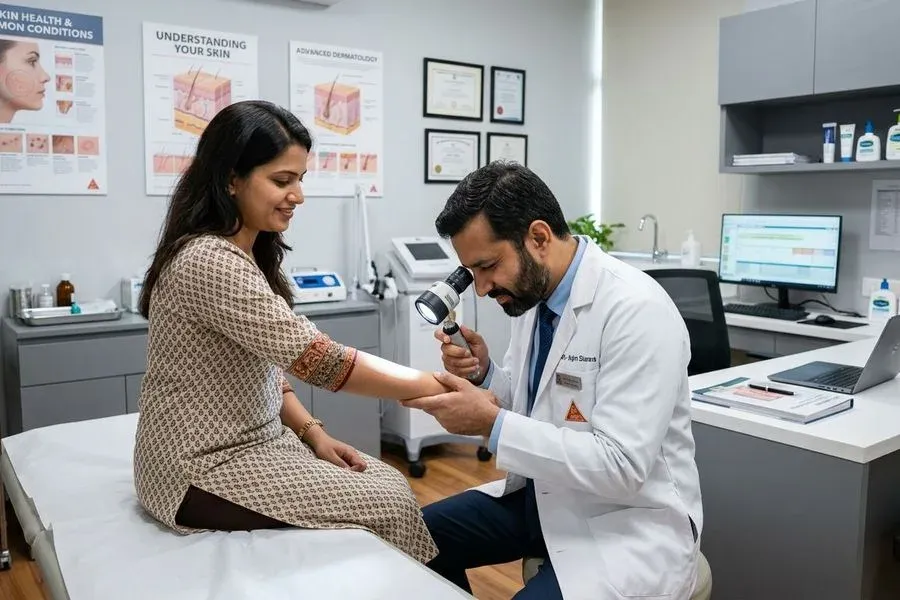
What do skin patients actually search for?
Nobody searches “androgenetic alopecia”. They search “hair fall treatment cost”. Nobody searches “tinea corporis”, they search “ring shaped rash on skin”.
So the page carries the patient’s words in its heading and its opening lines, and the clinical name follows inside where it belongs. That is not dumbing anything down. It is the difference between the page being found and the page being correct but invisible.
This is the same groundwork described under local SEO for clinics, applied to skin. Local SEO for doctors and clinics covers what a skin clinic specifically has to get right, and how patients choose a clinic online explains why the wording matters as much as the ranking. If you would like to see what patients currently find when they search for a clinic like yours, ask for a free written review, and if the honest answer is that your presence is already healthy, that is what it will say.
We also work with
Dental clinics
Dental patients arrive in two states, in pain, or thinking about it for months. One website has to answer both.
Physiotherapy
Physiotherapy patients search a body part and a problem, not a specialty. Your website has to be found at that level.
Ophthalmology
The person reading your cataract page is frequently not the patient. It is their son or daughter, comparing three hospitals on a phone.
Orthopaedics
Nobody books a knee replacement from the first website they read. Yours is usually the second or third, and it has to answer why you.
Paediatrics
Every other specialty is searched by the patient. Paediatrics is searched by a frightened parent, usually at night, asking whether to come now.
Multi-specialty
A multi-specialty hospital is eight practices sharing a building. Patients search for one of them, never for the building.
Gynaecology
A gynaecology patient often searches without telling anyone. The website has to answer her before she is willing to be seen enquiring.
ENT
An ENT practice serves a toddler with ear infections, an adult who cannot breathe through their nose, and a family buying a hearing aid.
Cardiology
Most cardiology searching happens in the two days after a scare, and it is done by a son or a wife, not by the patient.
Mental health
Nobody books a first appointment from a website. They read it four times over three months, and then they book.
Diagnostic centres
A diagnostic centre has two customers who never meet: the doctor who refers, and the patient who pays and compares.