
Physiotherapy · 2026
A physiotherapy site organised by where it hurts
A physiotherapy patient does not search for a physiotherapist. They search for their back. So this site is organised by the body, not by the equipment: eight conditions, six treatments, and every one of them linked to the others. The practice is invented and the page below says so first.
Gati Physiotherapy & Rehabilitation · A sample practice, written as Ahmedabad
A sample site. The practice, the doctor and every number in it are invented.

- Condition pages, named the way patients name them
- 8
- Condition pages, named the way patients name them
- Treatment pages, each linked to its conditions
- 6
- Treatment pages, each linked to its conditions
- Navigation, by body region, not by service
- Where it hurts
- Navigation, by body region, not by service
- Enquiry, call or WhatsApp, from any page
- Two taps
- Enquiry, call or WhatsApp, from any page
Before the build
The patient does not know what to call it
A physiotherapy clinic sells manual therapy, dry needling, electrotherapy and gait retraining. A patient in pain has never typed any of those words. They type "neck pain from laptop", or "how long after knee surgery can I walk", or just "back pain treatment near me". Most physiotherapy websites are built as a list of the machines in the room, which is an accurate description of the clinic and an invisible one to the person looking for it. This sample was built to show the other way round.
This is a sample. The clinic in it does not exist.
Gati Physiotherapy & Rehabilitation is not a practice. There is no clinic on SG Highway, the phone number does not ring, and Dr. Riya Mehta is not a person. We built the whole thing so that a physiotherapist deciding who to hire could open a finished site instead of judging a mockup.
Some things on it are invented in a way worth naming, because a real clinic cannot copy them:
- The “90% surgical avoidance” figure on the homepage. It is a placeholder. A real practice publishes a number like that only if it can show the audit behind it, or it does not publish it at all.
- The three patient recovery stories. Written for the sample. Real ones come from real patients, with consent, and they are worth ten times as much for exactly that reason.
- The insurer and TPA logos. Placeholders for the panels a clinic is genuinely empanelled with.
We would not put any of those on a live site without the evidence, and we do not invent them for clients. What this sample is showing you is the design, the structure and the build. The judgement about which claims a practice can honestly make is part of the work, and it belongs to the practice.
Why physiotherapy is the hardest specialty to organise
Most clinics can be described by what they do. A dental practice does root canals; a dermatology clinic does laser resurfacing. Name the treatment and you have named the page.
Physiotherapy breaks that, because the treatment and the complaint have almost no words in common. The clinic performs mobilisation and progressive loading. The patient has a shoulder that will not lift. Build the website around the first vocabulary and it will be accurate, professional and completely undiscoverable.
So this site is built around the second. The primary navigation asks “Where does it hurt?” and offers four parts of the body. Every condition is titled the way a patient would say it out loud. The clinical terms are all still there, one bracket later, doing the job of proving the clinic knows what it is talking about.
We argue this on our physiotherapy page and have done for a while. This is the first place you can see it working.
What the structure does that a template cannot
01
Entry by body region
The homepage opens with four body regions rather than a services menu. They are ordinary links, so they work before any script has loaded and on any phone. A patient who cannot name their condition still lands on the page about it.
02
A page for every condition, at the level people search
Eight of them, from tech neck to plantar fasciitis, each with the mechanism explained in plain words and a symptom checklist beside it. This is the layer that gets found, and the layer most physiotherapy sites skip entirely.
03
Conditions and treatments linked in both directions
Six treatment pages, each listing the conditions it is used for; eight condition pages, each listing the treatments that apply. A visitor can enter from either side and reach the other in one click, which is also how a search engine works out what the site is about.
04
The right structured data, not the generic kind
The site describes itself to Google as a PhysicalTherapy business rather than a generic local business, with its services, hours and practitioner attached, and marks the patient FAQ up as an FAQPage. It is a small file that decides how a clinic is understood.
The build is static, and no JavaScript framework is shipped to the browser at all. The only script on the site runs the mobile menu, and it handles the escape key and a click outside it properly. The FAQ that opens and closes, and every link in the condition mesh, is plain HTML doing what plain HTML has always done. That is why it opens quickly on a bad connection, and it is how we build for clinics.
What we would change for a real clinic
This is a sample, and being straight about its gaps is more useful than pretending it has none.
- It publishes no prices. That is the biggest gap. A patient comparing two physiotherapy clinics is trying to work out a total, not a per-session rate, and a clinic that publishes a session figure alongside a typical course length answers a question its competitors are ducking. A real build would carry both.
- The condition pages are short. The structure is right and it transfers unchanged, but a hundred words per condition is where a real practice’s own experience goes: what they see most, what they tell patients in the room, how long it actually takes here.
- The photography is stock and the practitioner is invented. Both get replaced. Stock imagery is a placeholder rather than a choice, and a patient can usually tell the difference between a real treatment room and a bought one.
- It is English only. The dental clinic we built and our dermatology sample both run in English and Gujarati throughout. A physiotherapy practice in Gujarat needs the same, and the recovery instructions especially.
What this sample is for
A physiotherapist, an orthopaedic surgeon running a rehab unit, or a sports clinic can open this on their own phone and see the standard before spending anything. Nothing here is a drawing. Load the conditions page, pick the body part that matches your own commonest complaint, and see whether the page you land on is the page you would want a patient to read.
If the structure is right for you, the same structure is what your clinic gets, with your treatments, your words and your prices in it. Our free written review is the place that starts, and if the honest answer is that your current site is fine, we will say so.
Inside the build
Six decisions, and what they look like
Every screenshot below is the deployed sample, not a drawing of one. The note beside each is the decision it shows, and each of those decisions carries over to a real build.
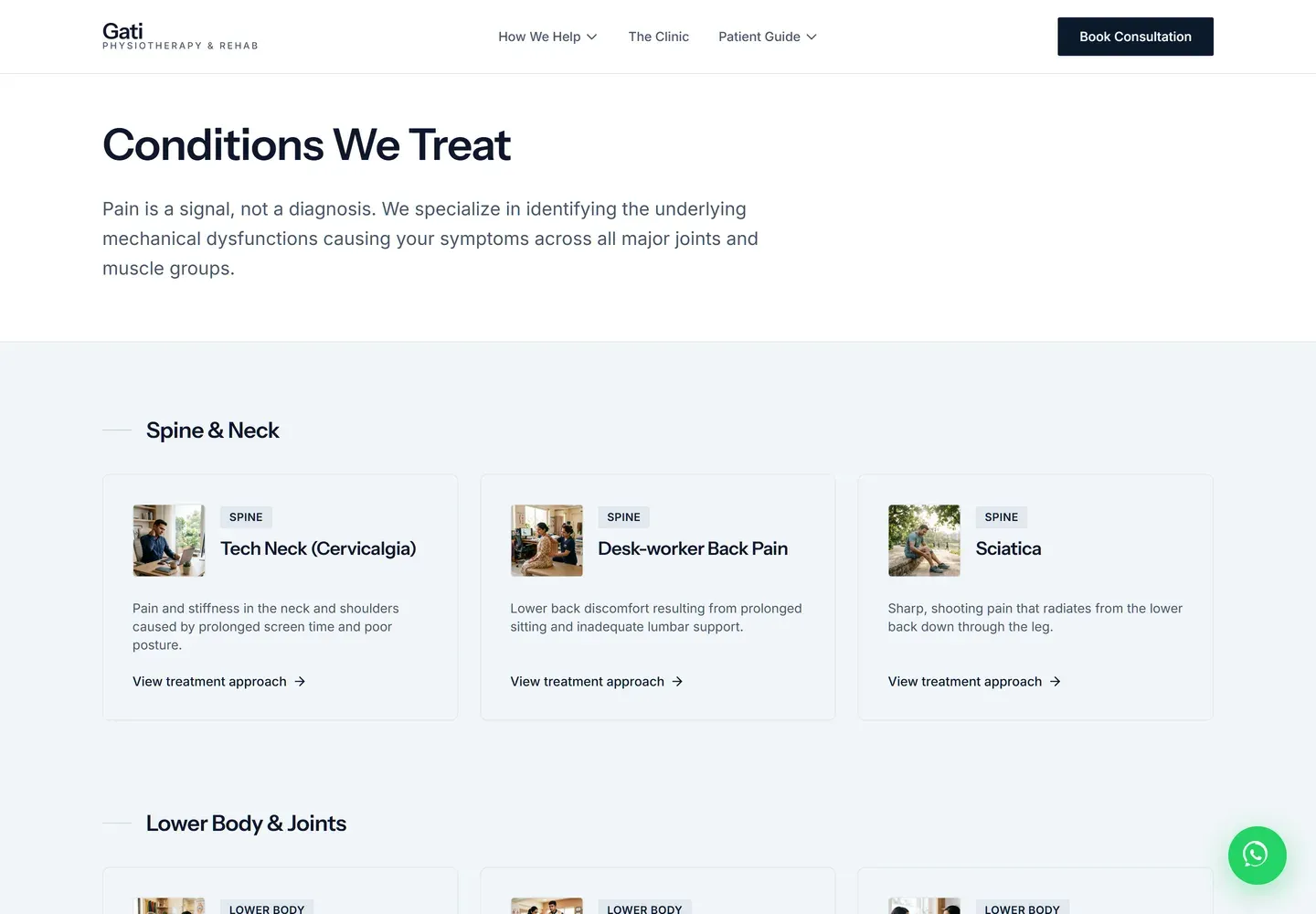
Sorted by the body, not by the price list
Eight conditions, grouped as Spine and Neck, Lower Body and Joints, Upper Body and Joints. A patient can place their own pain in one of those three groups in about a second, which is not true of a list headed Manual Therapy and Electrotherapy. The grouping is the navigation: it lets somebody who cannot name their problem still find the page about it.

The searched words first, the clinical word second
The page is called "Tech Neck", and "(Cervicalgia)" comes after it in brackets. That order is the whole decision. "Simplified Anatomy" then explains what is actually happening in the neck before it names anything, and the Common Symptoms panel beside it lets a patient check they are on the right page without reading a word of the body copy. A clinic gets found on the first phrase and believed on the second.
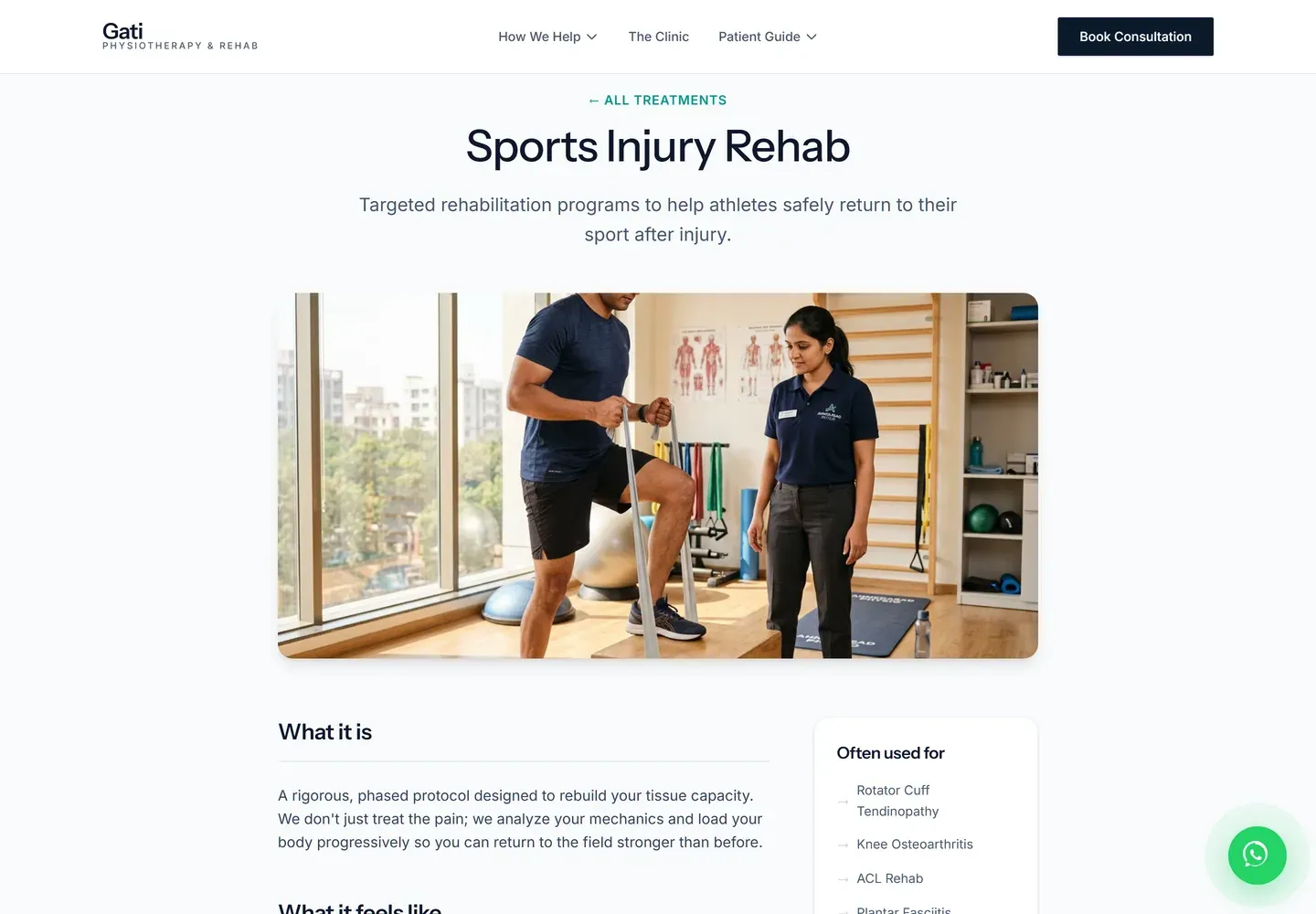
Every treatment names its conditions, and every condition names its treatments
The links run both ways. A patient who arrives on a condition page sees which treatments apply to it; a patient who arrives on a treatment page sees the conditions it is used for and can click straight into their own. Nobody has to reverse-engineer the connection from a menu. The second heading is worth noticing too: "What it feels like" answers the question a patient is too embarrassed to ask on the phone.
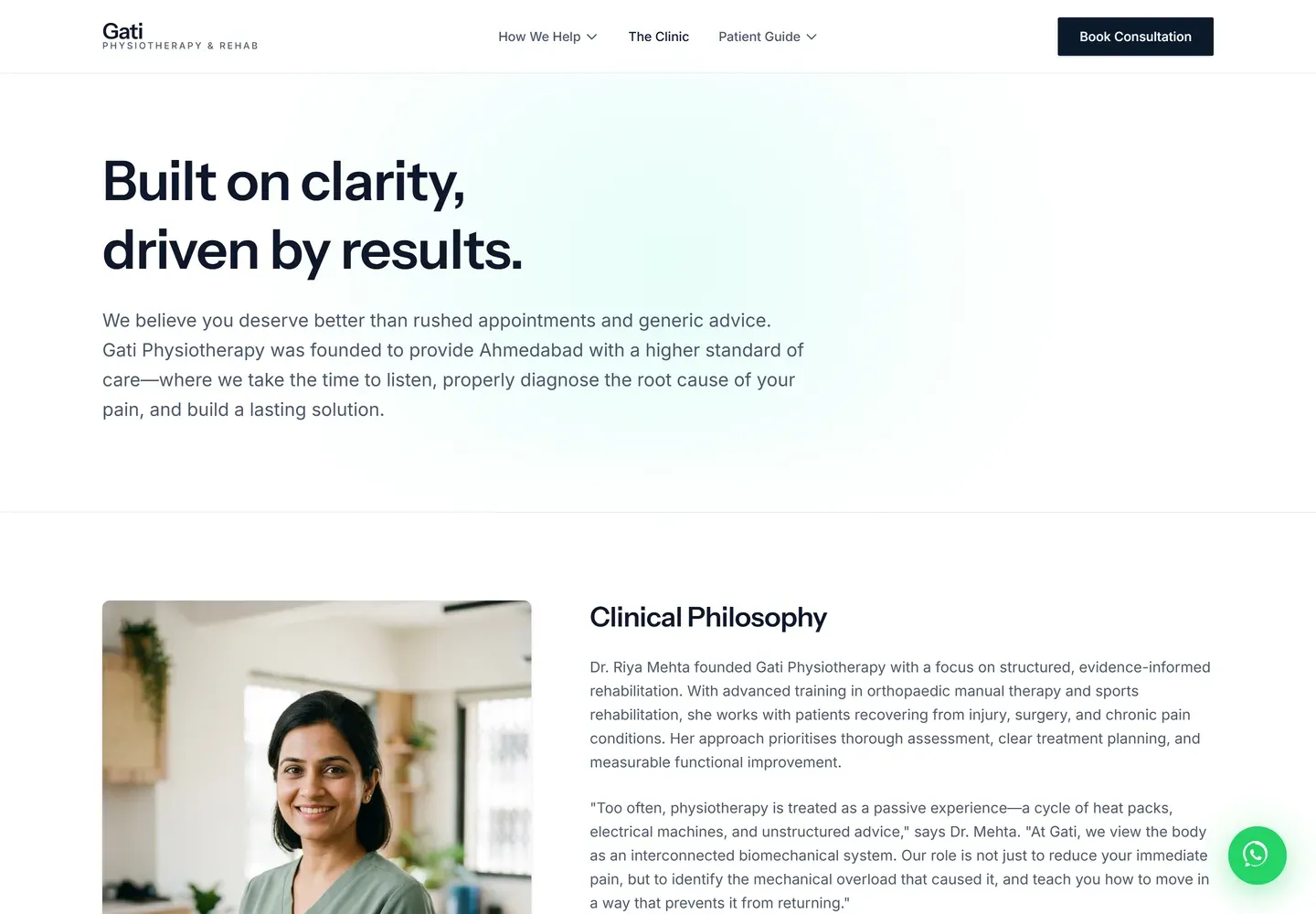
A named person, with their reasoning in their own words
The practitioner on this page is invented, and so are her qualifications. The slot she occupies is not. Physiotherapy is bought from a person rather than a building, and a patient choosing between two clinics is really choosing between two pairs of hands. So the page gives the lead therapist a name, a training history, a stated view of how recovery works, and a photograph, then quotes her directly rather than describing her. On a real build this is the page the practice writes and we structure.
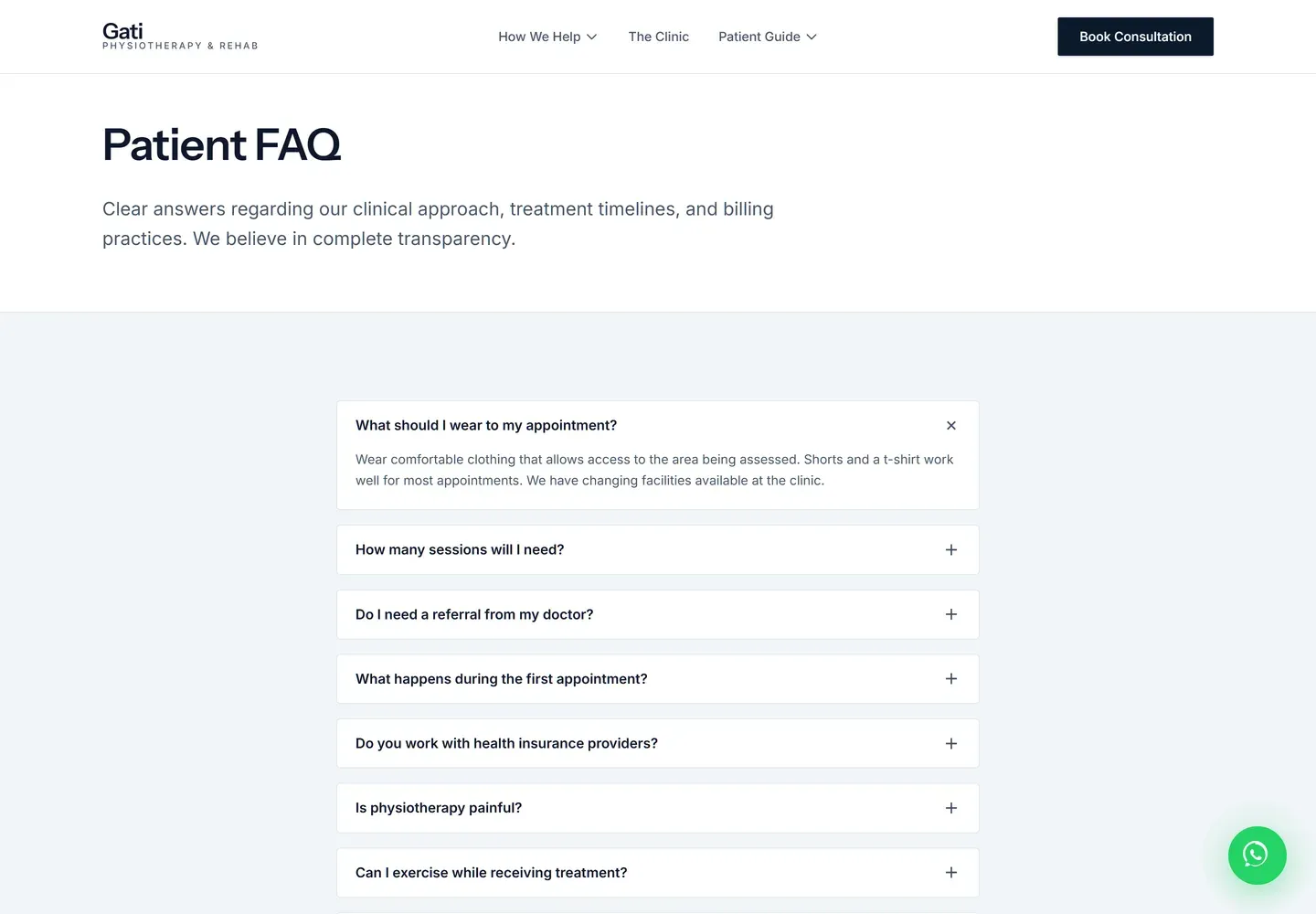
The three questions that stop a booking, answered in the open
How many sessions will this take. Do I need a referral first. Is it going to hurt. Every physiotherapy clinic hears those three before anybody books, and most websites leave all three to the phone call that never happens. Here they are on the page, with a number attached and a stated policy of discharging patients once they can manage alone. Answering the session-count question plainly does more for a booking rate than any claim about results, and it costs nothing but nerve.

Built for the phone it will be read on
Nearly every visitor arrives on a mid-range Android over mobile data, frequently in pain and often late at night. The call and WhatsApp bar is fixed to the bottom of every page, so an enquiry stays one tap away no matter how far into a condition page somebody has read. Nothing about that is decorative. A patient in pain should not have to scroll back to the top of a page to ask a question.